


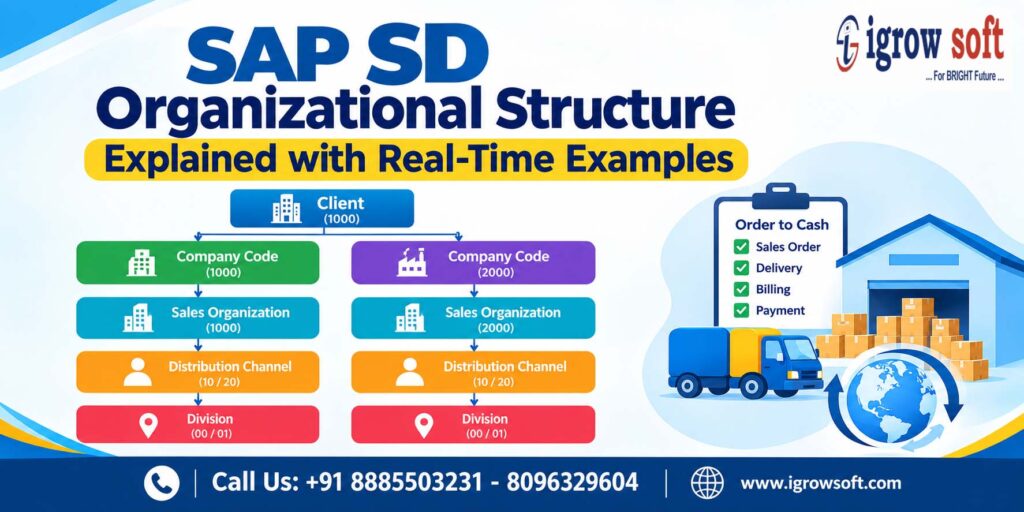
Understanding organizational structure is one of the first and most important steps for anyone learning SAP Sales and Distribution. The organizational structure determines how sales activities are arranged, controlled, and reported within an SAP system. For learners beginning their journey with SAP SD Igrowsoft, knowing the relationship between sales organization, distribution channel, division, sales area, plant, and storage location can make real-world configuration much easier to understand. Instead of viewing these elements as isolated terms, it is better to understand how they work together during actual business transactions.
What Is Organizational Structure in SAP SD?
The organizational structure in SAP SD represents the way a company organizes its sales and distribution operations in the system. Different organizational units are assigned specific responsibilities, such as selling products, managing distribution channels, supplying goods, and handling inventory.
The main organizational elements commonly used in SAP SD include:
- Sales Organization
- Distribution Channel
- Division
- Sales Area
- Plant
- Storage Location
- Shipping Point
Each element has a specific role. Their relationships determine how a sales order is processed from the initial customer request through delivery and billing.
1. Sales Organization
A sales organization represents a unit responsible for selling products or services and managing customer relationships. It is one of the most important organizational units in SAP SD.
For example, imagine a company called ABC Electronics operating in India, the United States, and Germany. The company may create separate sales organizations for each major market:
- 1000 – India Sales
- 2000 – USA Sales
- 3000 – Germany Sales
A sales organization can have its own pricing policies, customer agreements, sales targets, and reporting requirements. When a sales order is created, the appropriate sales organization identifies which business unit is responsible for the sale.
2. Distribution Channel
A distribution channel describes how products or services reach customers.
Typical distribution channels include:
- 10 – Direct Sales
- 20 – Wholesale
- 30 – Retail
- 40 – Online Sales
Consider ABC Electronics again. The company may sell laptops directly to corporate customers while also supplying products to wholesalers. Both transactions can use the same sales organization but different distribution channels.
This distinction allows businesses to maintain different pricing, sales strategies, customer groups, and reporting structures for different routes to market.
3. Division
A division represents a group of products or services offered by an organization.
For example, an electronics company could have:
- 01 – Computers
- 02 – Mobile Devices
- 03 – Accessories
A company selling laptops and mobile phones can use divisions to separate product-related sales activities. Division information can also influence master data, reporting, and sales processes.
4. Sales Area
A sales area is a combination of Sales Organization + Distribution Channel + Division.
For example:
Sales Organization: 1000 – India Sales
Distribution Channel: 10 – Direct Sales
Division: 01 – Computers
Together, these three elements create a sales area.
Sales area data is important because customer master data and many sales-related processes are maintained according to the relevant sales area. In a real implementation, consultants must carefully determine which combinations are required instead of creating unnecessary organizational structures.
For learners pursuing SAP SD online training, understanding sales areas through practical business scenarios is much more effective than memorizing definitions. A simple way to remember the concept is: Who is selling + How are they selling + What are they selling?
5. Plant
A plant represents a location where materials are produced, stored, or supplied. Although plants are particularly important in logistics and inventory management, they also play a major role in the SD sales process.
For example, ABC Electronics may have:
- 1100 – Hyderabad Plant
- 1200 – Mumbai Plant
- 1300 – Delhi Plant
When a customer places an order, SAP can determine the appropriate delivering plant based on factors such as customer data, material availability, and configuration.
The plant therefore connects sales activities with physical product availability. This becomes particularly important during delivery creation and availability checks.
6. Storage Location
A storage location identifies a specific area within a plant where stock is physically managed.
Suppose the Hyderabad plant has the following storage locations:
- 0001 – Main Warehouse
- 0002 – Finished Goods
- 0003 – Returns
The plant tells SAP where the business location is, while the storage location identifies where stock is kept within that plant.
Storage locations become particularly useful when inventory needs to be separated according to business requirements. For example, finished products may be stored separately from returned or damaged products.
7. Shipping Point
A shipping point is responsible for processing outbound deliveries. It represents the organizational unit from which goods are shipped to customers.
For example:
- 1100 – Hyderabad Shipping Point
- 1200 – Mumbai Shipping Point
SAP can determine a shipping point based on factors such as the delivering plant, shipping conditions, and loading group.
Imagine a customer orders a laptop from the Hyderabad plant. Once the sales order is processed, SAP determines the delivering plant and shipping point. The shipping team can then create and process the outbound delivery from the appropriate location.
8. Real-Time Example of SAP SD Organizational Structure
Let’s consider a practical scenario. ABC Electronics sells laptops to corporate customers across India. The company uses sap sd online in Hyderabad as part of its learning and implementation preparation, while its actual business structure contains an India sales organization, direct-sales distribution channel, and computer division.
A simplified structure could look like this:
Sales Organization: 1000 – India Sales
↓
Distribution Channel: 10 – Direct Sales
↓
Division: 01 – Computers
↓
Sales Area: 1000 / 10 / 01
↓
Plant: 1100 – Hyderabad
↓
Storage Location: 0002 – Finished Goods
↓
Shipping Point: 1100 – Hyderabad Shipping
Now assume a corporate customer orders 50 laptops. The sales representative creates a sales order using the relevant sales area. SAP checks customer and material information, determines pricing, identifies the supplying plant, and supports the subsequent delivery and billing process.
This example shows why organizational structure is not merely theoretical. Each organizational unit contributes to the complete sales process.
Why SAP SD Organizational Structure Matters
A correctly designed organizational structure provides consistency and control throughout the sales process. It helps businesses manage different markets, products, distribution methods, warehouses, and shipping operations.
It also affects important areas such as:
- Customer master data
- Material master data
- Pricing
- Sales order processing
- Delivery processing
- Shipping
- Billing
- Revenue reporting
- Sales analysis
Poor organizational design can create problems later in configuration and transaction processing. Therefore, consultants should understand the business requirements before creating organizational units.
Final Thoughts
SAP SD organizational structure forms the foundation of the sales process. Sales organizations define responsibility for selling, distribution channels define how products reach customers, divisions classify products, and their combination creates the sales area. Plants, storage locations, and shipping points then connect sales activities with inventory and logistics operations.
For beginners, the best approach is to learn each organizational unit individually and then understand how they work together in a complete Order-to-Cash scenario. Once this relationship becomes clear, topics such as pricing, sales orders, delivery, billing, and configuration become much easier to understand.
A strong understanding of organizational structure is therefore essential for anyone preparing for an SAP SD consultant role or working on practical SAP implementation projects.